Case Study: How AI-Powered Agentic Agency Turned Around a Struggling Startup

Most startup autopsies read the same way. Product-market fit felt close but never clicked. The team was smart. The market was real. And yet the business kept bleeding, month after month, in the quiet, demoralizing way that doesn't make for a dramatic failure story, just a slow unwinding.
This case study is about a startup that looked like it was heading toward that outcome, and what happened when it stopped trying to solve an execution problem with more execution and started rebuilding around an AI-powered agentic agency model instead. The results were not guaranteed. Neither was the path. But the lessons are concrete, and we think they apply well beyond this one company.
The Situation: Misalignment Was the Real Problem
The startup came to us operating in a crowded MarTech-adjacent category. On paper, the product addressed a genuine pain point. In practice, the go-to-market approach was misaligned with how their target customers actually made buying decisions. They were selling a workflow solution to people who hadn't yet internalized the workflow problem.
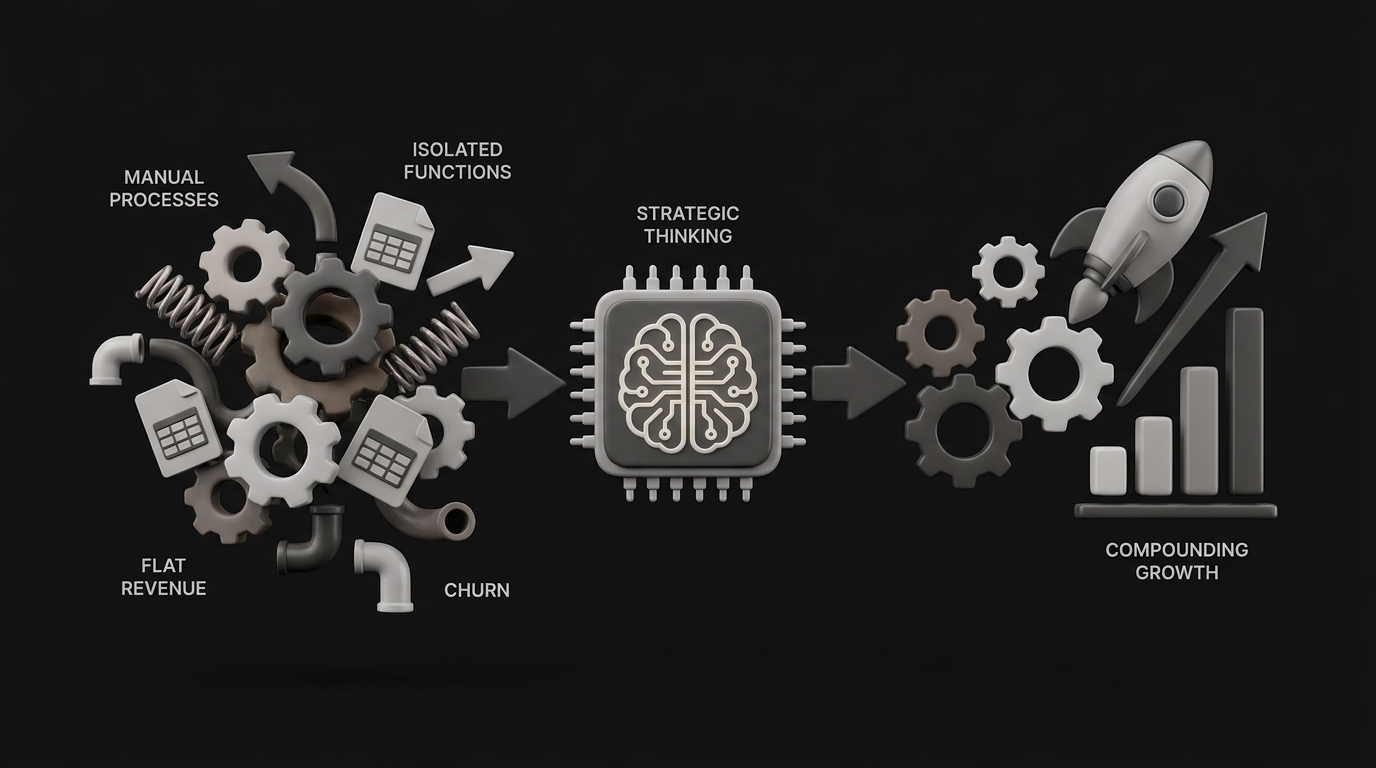
Operationally, the picture was just as tangled. The team was handling customer outreach, content production, campaign management, and lead qualification largely through manual processes stitched together with spreadsheets and gut instinct. Each function worked in isolation. Data that lived in one part of the business never informed decisions in another. The result was a kind of organized chaos: busy, but not compounding.
Revenue was flat. Customer churn was climbing. And the founding team, stretched thin across every function, had no real bandwidth left for the strategic thinking the business actually needed.
The instinct in that situation is almost always to hire. More salespeople, more content, more hands on deck. We pushed back on that instinct early, because the problem was not capacity. It was signal clarity. The team did not have a reliable read on which customers were actually worth pursuing, which messages were landing, or which parts of the funnel were silently leaking.
What Agentic Agency Actually Looked Like in Practice
We introduced an agentic agency layer built around AI systems that could not just automate tasks but reason across them. This is an important distinction. Basic automation handles repetitive work. Agentic systems handle coordination, which is a fundamentally different capability and a much harder problem.
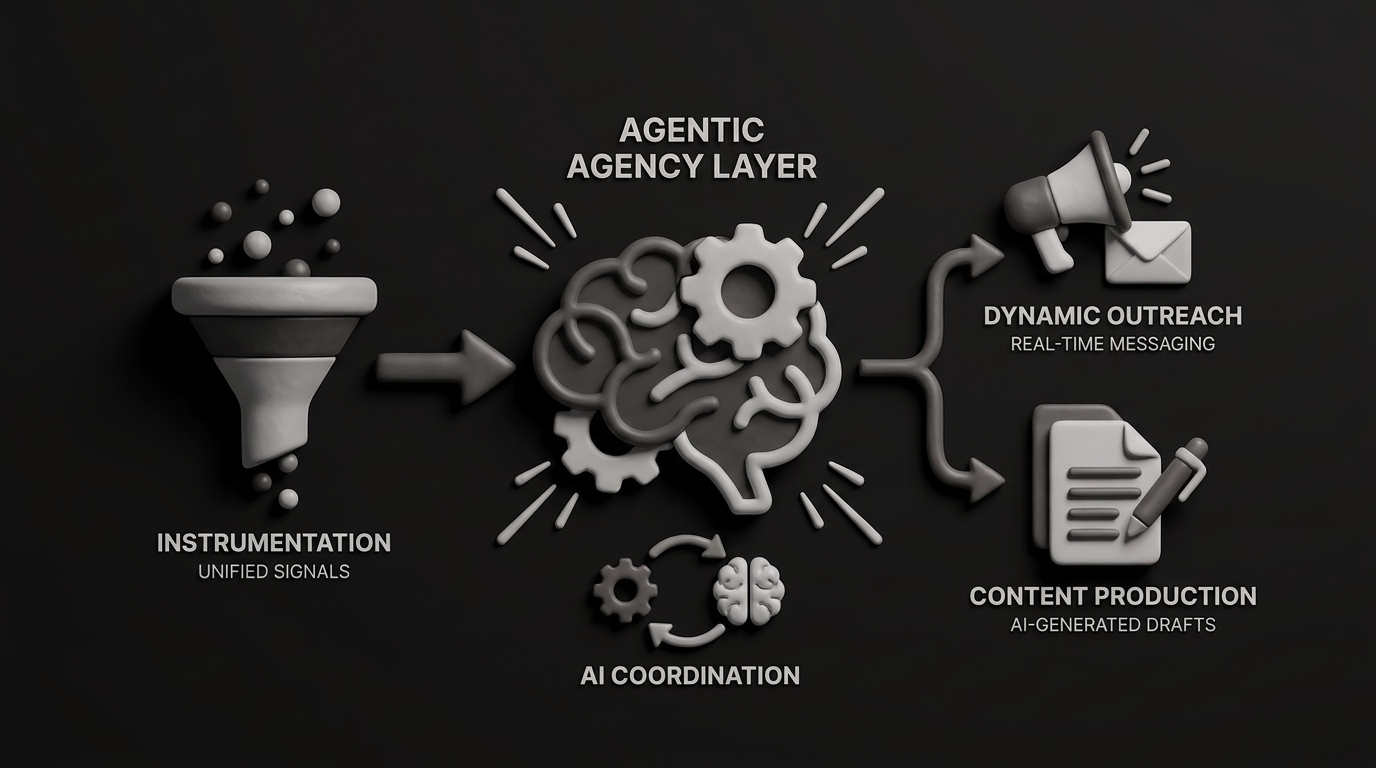
The first move was instrumentation. Before anything could be optimized, the business needed a coherent data model: unified customer signals, engagement history, conversion patterns, and behavioral indicators all flowing into a single source of truth. This sounds foundational because it is. Most startups skip it, and it costs them enormously later.
Once that foundation was in place, the agentic systems could begin doing useful work. Customer segmentation shifted from demographic buckets to behavioral clusters, driven by actual engagement data rather than assumptions. Outreach sequences became dynamic, adjusting messaging based on real-time signals rather than static cadences. Content production, previously a bottleneck that consumed significant founder time, moved to a model where AI handled first-draft generation and distribution logic while the team focused on editorial judgment and strategic framing.
Lead qualification, historically a manual and inconsistently applied process, became a scored and prioritized system that surfaced the highest-intent prospects automatically. The sales team stopped working every lead the same way and started concentrating effort where the data said it actually mattered.
Critically, none of this ran without human oversight baked in at every stage. The agentic systems made recommendations and executed on approved parameters, but a human remained in the loop for decisions that carried meaningful risk or required contextual judgment that the system could not reliably apply. That boundary, between what the AI ran and what a person owned, was not an afterthought. It was designed deliberately, and it mattered.
The Results, Without Inflating Them
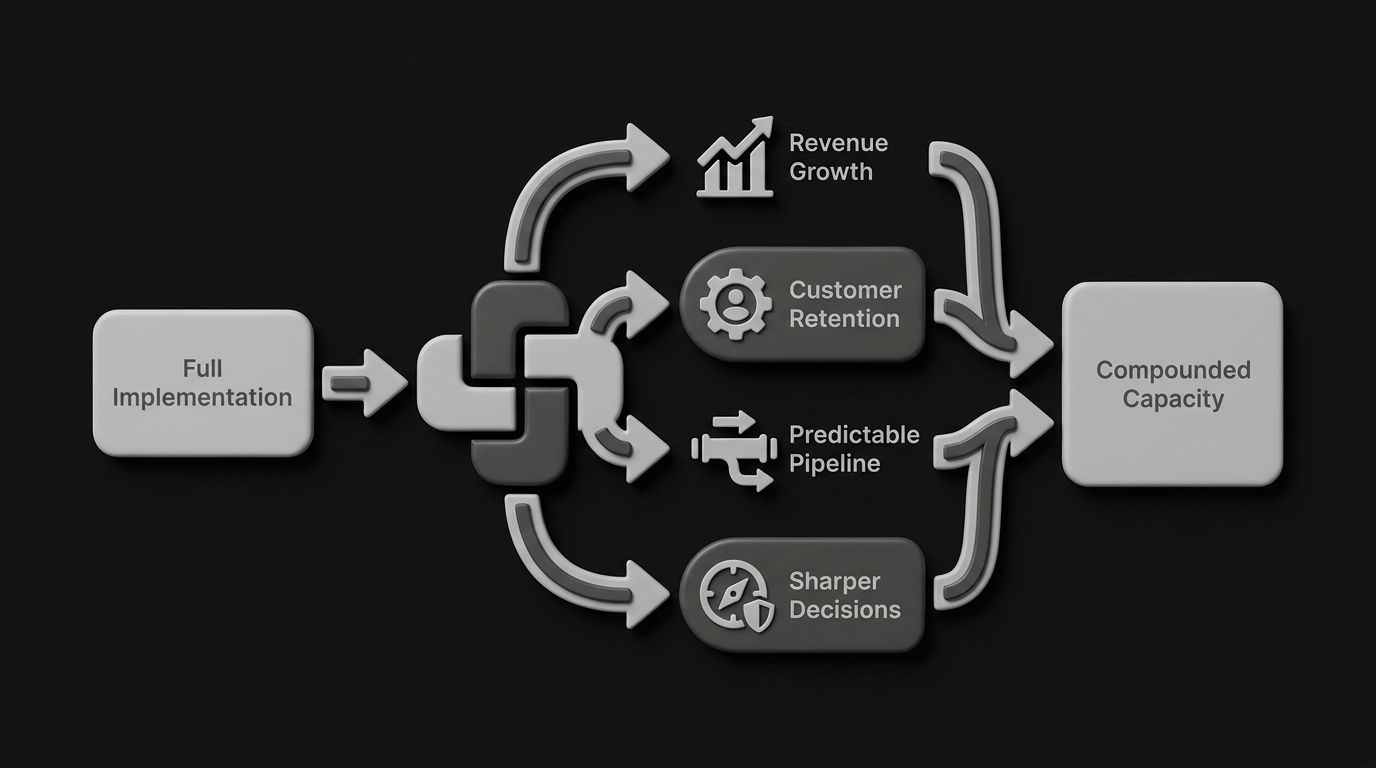
Within two quarters of full implementation, the business saw measurable movement across the metrics that had been most stubbornly flat. Revenue grew. Customer retention improved, meaningfully and not just at the margin. The pipeline became more predictable because the qualification layer was producing cleaner, higher-signal inputs to the sales process.
Market positioning also shifted in a way that was less immediately quantifiable but equally important. With the operational burden reduced and the data model finally generating useful signal, the founding team could invest real time in category positioning and product differentiation. They made sharper decisions about which customer segments to pursue and which to walk away from, a choice that had previously felt too risky to make clearly.
The team did not grow headcount significantly during this period. That was by design. The goal was to compound the capacity they already had, not add complexity, and the agentic layer made that possible by absorbing the coordination and execution work that had been consuming the team's most valuable hours.
None of these results came from the AI working independently. They came from a system where AI handled the high-volume, high-frequency work with precision, and people handled the high-stakes, high-ambiguity calls with judgment. That combination, not the technology alone, was the actual driver of the turnaround.
What We Took Away From This
A few things crystallized for us through this engagement that we think generalize well.
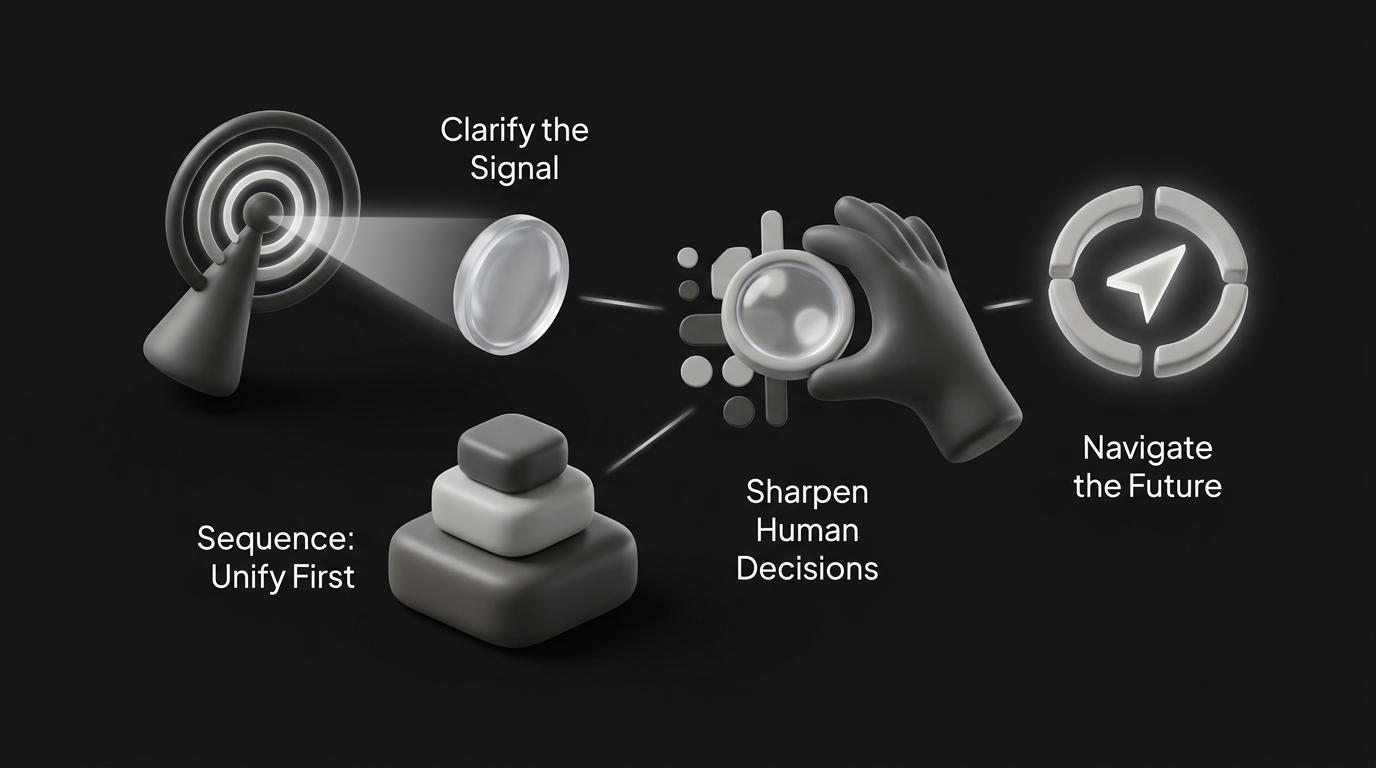
The first is that operational inefficiency in early-stage startups is rarely a process problem. It is almost always a signal problem. Teams are not failing to execute; they are executing without knowing what to optimize for. Agentic systems are most powerful when they are solving that problem, not just speeding up existing workflows.
The second is that the sequencing matters enormously. Agentic tools deployed on top of a fragmented data model will optimize the wrong things faster. The instrumentation and unification work has to come first, even when it feels slower and less exciting than shipping the automation layer.
The third is about the human role in an agentic model, which is not diminished but it is different. The founders in this case did not become passive observers of an AI-run operation. They became more strategic because the system freed them to be. The quality of their decisions improved because the quality of the information feeding those decisions improved. That is the actual value proposition, not labor replacement but decision sharpening.
The fourth, and maybe the most honest: agentic agency is not a rescue mechanism for a fundamentally broken business model. It accelerated what was already a viable core product with a solvable go-to-market problem. If the underlying product had not addressed a real need, no amount of AI-powered orchestration would have changed the outcome. The technology amplified a signal that was already there. It did not manufacture one.
How This Applies to Your Venture
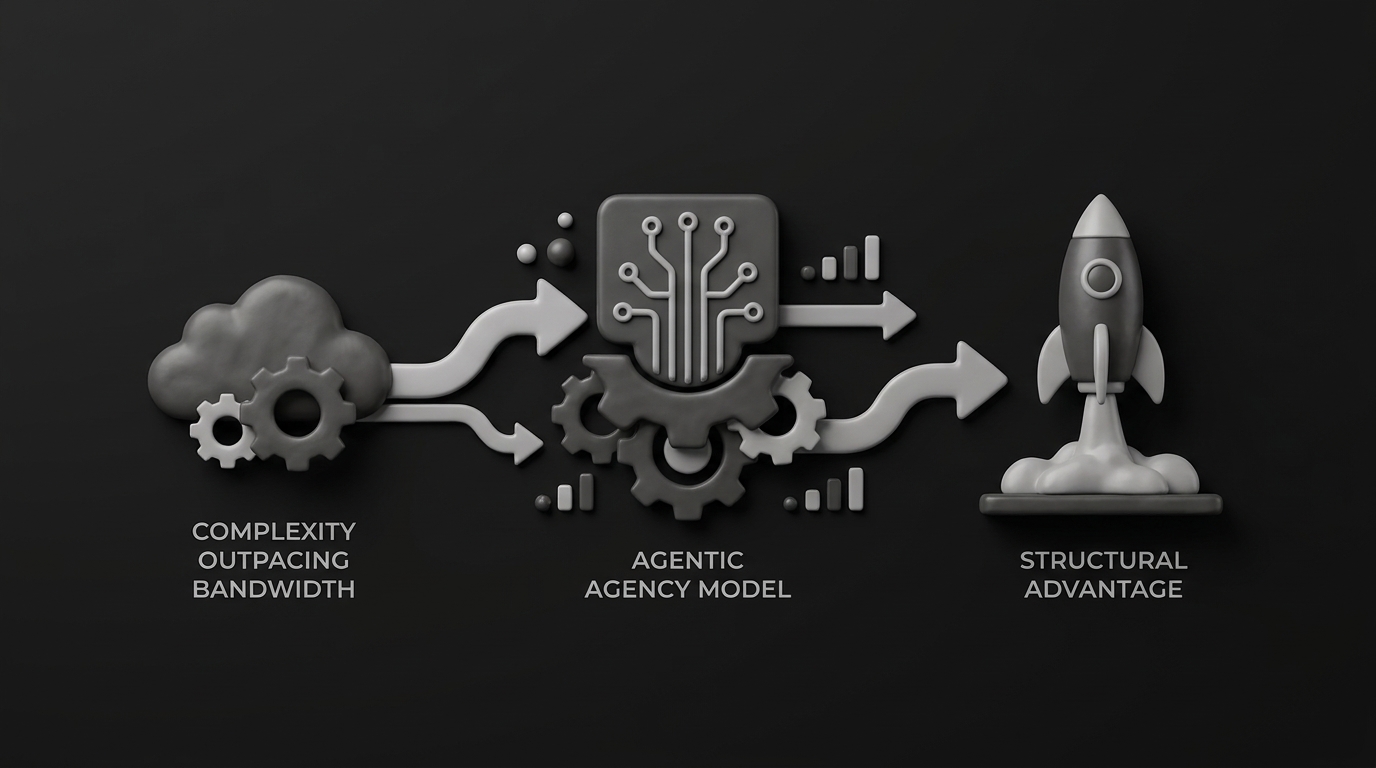
If you are building in a category where execution complexity is outpacing your team's bandwidth, the agentic agency model deserves serious consideration. Not as a shortcut, but as a structural decision about how the business compounds.
The questions worth sitting with are practical ones: Where is your team spending time that a well-designed AI system could handle with higher consistency and lower cost? Where are you making decisions without reliable data, and what would it take to fix that? Where does the business need human judgment most, and is that actually where your best people are spending their hours?
Those questions do not have easy answers, and the implementation is never as clean as a case study makes it look. But the direction is clear. Startups that figure out how to combine genuine human insight with well-scoped agentic execution are building with a structural advantage that compounds over time.
That is the thing worth building toward.