11X Ventures
next-gen AI platforms & web experiences
AI Native Isn't a Feature. It's a Decision to Build Everything You Depend On.
Voice as a Confidence Engine How Conversational AI Turns Messy Thoughts Into Clear Decisions
social
Product Thinking Is Dead. Here's Why Venture Building Is the New Baseline.
If you are building a product in 2025 and calling it a product, you are already behind.
That might sound harsh, but it is the clearest way we know how to say it. "Product" as a concept, as a goal, as the thing you are building toward, is no longer enough. It never fully was, but for a long time, the industry let founders get away with treating it like the finish line. Ship something useful, design it well, run it through a development cycle, get some feedback, iterate. That was the playbook. And for a while, it worked well enough.
It does not work anymore.
What we have seen, building internally at 11X Ventures and working alongside founders and operational groups who are trying to launch ventures of their own, is that the companies that treat product as the endpoint almost always stall. They build something real, something functional, sometimes even something genuinely good, and then they wonder why nothing is happening. Why users are not coming. Why revenue is not materializing. Why the market does not seem to care.
The answer is usually the same. They optimized for the product. They forgot to build the venture.
## From Waterfall to Agile to Venture: Every Shift Is About Compressing the Feedback Loop
To understand why venture building is now the baseline, it helps to trace how we got here.
When software development lived under the waterfall model, teams would spend months, sometimes years, planning and building before anything shipped. The feedback loop was enormous. By the time a product reached users, the assumptions baked into it were already stale. Agile was the correction. Shorter cycles, faster releases, continuous iteration. The core insight was that you do not want to wait too long to get any value-driven output into the world. Ship fast, learn fast, improve.
Agile changed how we build. But most teams, even agile ones, stayed focused on the product itself. Customer feedback shaped features. Velocity shaped timelines. The loop got tighter, but it was still a product loop.
What is happening now is one layer up from that. The feedback loop has expanded again, but in a different direction. It is not just about what features to release or what the product can do. It is about whether the thing you are building can generate real value, solve a problem people are actually willing to pay for, and find its place in a market that is not waiting around for you.
That is the venture layer. And if you are not building with it in mind from the start, you are essentially running agile sprints toward a wall.
## What Venture Building Actually Means in Practice
When we talk about venture building at 11X Ventures, we mean something specific. It is not a rebrand of product development. It is not just adding a go-to-market slide to your pitch deck. It is a fundamental shift in what you are optimizing for.
Pure product thinking asks: what should this do, and how well does it do it?
Venture thinking asks: who is this for, what are they willing to pay, how do we reach them, and what does this look like at 10X or 100X scale?
Those are very different questions, and they lead you to very different decisions early on. The best products we have seen fail, and we have seen a lot, failed because the team answered the first set of questions brilliantly and never seriously engaged with the second set. Great execution, wrong foundation.
For us, the filter is straightforward. Before we commit to building anything, we want to see real indicators: that the market exists, that there is a revenue opportunity, and that this has a viable path to becoming something much larger. Not just a useful tool. A venture. If those indicators are not there, we are not building, we are experimenting. And experiments without a venture thesis are just expensive hobbies.
User acquisition and monetization are part of this, but the sequencing matters. Our bias is to get users in first, prove that the value is real, and then layer in the monetization signals as you go. Paywalls and premium features make sense once you have demonstrated something worth paying for. The mistake is trying to charge before you have shown the value, or worse, building for revenue so aggressively that you never actually build a user base worth monetizing.
The B2B versus consumer distinction is worth naming here because it changes the math significantly. On the consumer side, the amount you can charge per user is limited, so volume becomes the lever. On the B2B side, you can command significantly higher prices, which means even a relatively small base of customers can generate meaningful revenue signals. The approach to validation, to pricing, to what traction actually means, shifts depending on which side of that line you are on.
## The Dual-Track Model: How 11X Ventures Actually Operates
At 11X Ventures, we run on two tracks simultaneously, and we think this model is part of what makes venture building sustainable rather than just theoretical.
The first track is internal. We build our own products. Bono AI is the clearest example of this right now. It started as a hypothesis built around a web-based model, then evolved into a voice-first content platform as we learned more about where the real value sat. That kind of iteration is normal and expected. But throughout that process, we were not just asking product questions. We were asking venture questions: Is there a market here? Are the right signals showing up? Can this become something that justifies the commitment?
The second track is external. We work with founders and operational teams who are looking to launch ventures and who come with something we cannot manufacture: deep domain expertise in a specific industry or problem space. They know the market. They understand the customer in ways that take years to develop. We team up with them to make sure what they are building has a viable venture path, and we do the due diligence to make sure we are picking the right people to work with. When it is a match, we double down completely.
Together, these two tracks are essentially the operating model. We bring the venture-building infrastructure, the product instinct, the distribution thinking, the architecture of how you go from idea to something that can actually grow. The partners bring the subject matter depth. Neither is sufficient on its own.
## The Shift You Cannot Afford to Miss
There is a version of product development that still treats go-to-market as something you figure out after the product is done. That version is a trap. By the time you are done, the window has shifted, the assumptions have aged, and you are playing catch-up in a market that was not waiting for you.
The teams that are winning right now, the ones building things that actually take hold, are not building products and then figuring out the venture. They are building ventures from the start, and the product is one critical output of that process, not the whole thing.
At 11X Ventures, this is not a philosophy we arrived at by reading about it. It is something we built our way into by doing it, by watching what fails and doubling down on what works. The clearest thing we can say to any founder or operator thinking about what to build next: the question is not "what should the product do?" It is "what does the venture look like, and does the market actually want it to exist?"
Start there. Everything else, the features, the design, the tech stack, follows.
The Human Cost of Moving Fast in AI Nobody Talks About

Everyone talks about the risks of moving too slow in AI. Not enough people talk about what happens when you move too fast.
I'm building multiple AI products at the same time. That means context-switching constantly, making high-stakes decisions without complete information, and pushing a team to keep pace with a space that genuinely does not wait. And I'll be honest: the technical challenges are not the hard part. The hard part is the human stuff underneath it all.
Burnout and Decision Fatigue Are the Real Hidden Costs
When you're building in an AI-native environment, the pace is relentless. There's always a new model, a new capability, a new competitive signal telling you to move faster. That pressure is real and it compounds quietly.
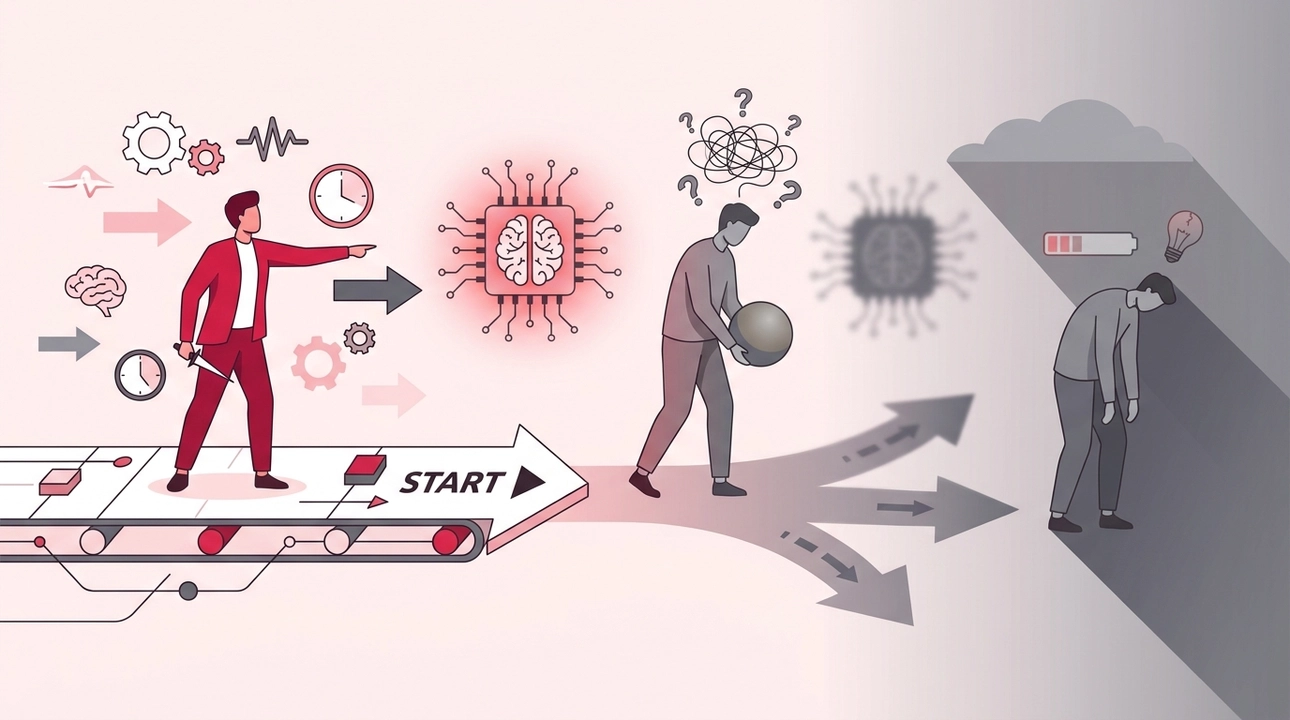
Decision fatigue sets in before you notice it. You start the week sharp, making clear calls. By Thursday you're second-guessing things that should be obvious, or worse, you stop questioning things that deserve scrutiny. That erosion is not dramatic. It's subtle. And it's dangerous.
Founder burnout follows a similar pattern. It doesn't announce itself. It shows up as shorter patience with your team, less curiosity about the product, a growing gap between the energy you're projecting and the energy you actually have. If you're running a venture studio and shipping multiple products simultaneously, you're multiplying those pressure points, not just adding them.
The part that gets me is that the same urgency driving the innovation is the thing quietly degrading the judgment you need to innovate well. That's a real tension.
Team Dynamics Break Down Before the Product Does
Here's what I've seen happen on teams: the pressure to ship fast gets internalized as a personal performance standard. People stop raising concerns because raising concerns feels like slowing down. That silence is one of the most expensive things a startup can accumulate.
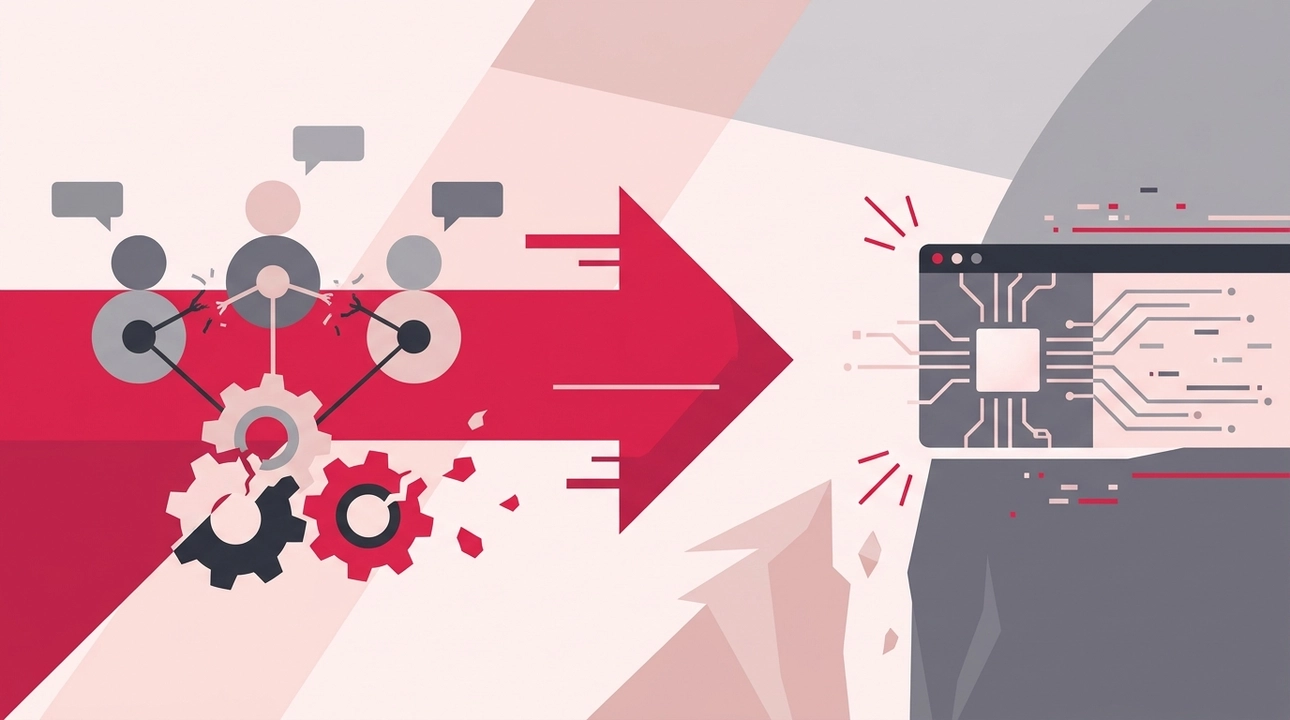
When team dynamics suffer, it doesn't always show up in a missed deadline or a bad release. It shows up in the quality of conversations. In whether people are still bringing their real thinking to the table or just executing to stay in motion. That distinction matters enormously, especially in AI product work, where the feedback loops are fast and the cost of shipping something misaligned is high.
The pressure to innovate quickly doesn't just compromise output. It compromises the relationships and the psychological safety that good output actually depends on.
Saying This Out Loud Matters
Part of why I wanted to write this is that these things don't get said enough. The narrative around building in AI tends to be about speed, scale, and momentum. Which is all real. But the human cost runs alongside all of it, and pretending otherwise does a disservice to anyone who's in the thick of it.
There's something valuable about naming the struggle while you're inside it, not just in a retrospective once the company's a success story. It makes the experience more honest, and it creates space for others who are feeling the same weight to recognize they're not just not cut out for this. They're just human.
Recognizing the human cost isn't a soft concern sitting beside the real work. It is part of the real work. The founders and teams who build durable things in AI are not the ones who pushed through burnout the longest. They're the ones who figured out how to stay sharp, stay honest, and stay connected to the people they're building with.
That's the only version of fast that actually compounds over time.
About Us
Crafting what's next...

At 11X Ventures, we believe in the power of transformative ideas and innovative technologies to shape the future. As a venture studio, we are dedicated to building and investing in digital platforms and technologies that redefine possibilities and empower individuals and businesses alike.
Founded by Zeeshan Rasool, 11X Ventures embodies the vision of achieving extraordinary growth and returns. The name "11X" reflects our commitment to driving 11x growth and impact in everything we pursue, pushing boundaries and unlocking potential.
Our journey is driven by a passion for creating AI-native solutions with seamless UX. By focusing on user-centric design, mobile-first principles, and cutting-edge technology, we aim to unlock the next generation of digital experiences. We are currently working on products in digital identity, the knowledge economy, and immersive events.
At 11X Ventures, we are more than just a venture studio—we are a team of visionaries, innovators, and creators united by a shared mission to inspire growth and drive progress. Join us as we chart a path toward a brighter, more connected tomorrow.
Subscribe for Updates
Subscribe to get early access to our products, behind-the-scenes updates, and exclusive content!
The Human Cost of Moving Fast in AI Nobody Talks About

Everyone talks about the risks of moving too slow in AI. Not enough people talk about what happens when you move too fast.
I'm building multiple AI products at the same time. That means context-switching constantly, making high-stakes decisions without complete information, and pushing a team to keep pace with a space that genuinely does not wait. And I'll be honest: the technical challenges are not the hard part. The hard part is the human stuff underneath it all.
Burnout and Decision Fatigue Are the Real Hidden Costs
When you're building in an AI-native environment, the pace is relentless. There's always a new model, a new capability, a new competitive signal telling you to move faster. That pressure is real and it compounds quietly.
Decision fatigue sets in before you notice it. You start the week sharp, making clear calls. By Thursday you're second-guessing things that should be obvious, or worse, you stop questioning things that deserve scrutiny. That erosion is not dramatic. It's subtle. And it's dangerous.
Founder burnout follows a similar pattern. It doesn't announce itself. It shows up as shorter patience with your team, less curiosity about the product, a growing gap between the energy you're projecting and the energy you actually have. If you're running a venture studio and shipping multiple products simultaneously, you're multiplying those pressure points, not just adding them.
The part that gets me is that the same urgency driving the innovation is the thing quietly degrading the judgment you need to innovate well. That's a real tension.
Team Dynamics Break Down Before the Product Does
Here's what I've seen happen on teams: the pressure to ship fast gets internalized as a personal performance standard. People stop raising concerns because raising concerns feels like slowing down. That silence is one of the most expensive things a startup can accumulate.
When team dynamics suffer, it doesn't always show up in a missed deadline or a bad release. It shows up in the quality of conversations. In whether people are still bringing their real thinking to the table or just executing to stay in motion. That distinction matters enormously, especially in AI product work, where the feedback loops are fast and the cost of shipping something misaligned is high.
The pressure to innovate quickly doesn't just compromise output. It compromises the relationships and the psychological safety that good output actually depends on.
Saying This Out Loud Matters
Part of why I wanted to write this is that these things don't get said enough. The narrative around building in AI tends to be about speed, scale, and momentum. Which is all real. But the human cost runs alongside all of it, and pretending otherwise does a disservice to anyone who's in the thick of it.
There's something valuable about naming the struggle while you're inside it, not just in a retrospective once the company's a success story. It makes the experience more honest, and it creates space for others who are feeling the same weight to recognize they're not just not cut out for this. They're just human.
Recognizing the human cost isn't a soft concern sitting beside the real work. It is part of the real work. The founders and teams who build durable things in AI are not the ones who pushed through burnout the longest. They're the ones who figured out how to stay sharp, stay honest, and stay connected to the people they're building with.
That's the only version of fast that actually compounds over time.
Contact Us
How can we help you?
Ventures
Bono AI
Meet Bono, your AI content strategist. Have a quick conversation and watch it turn into blog posts, social content, and more. Built for executives, consultants, creators, and founders.
Hangeh
Your building's social network and marketplace. Meet your neighbours, make friends, exchange things, and live your best life.
Propflow AI
AI powered community platform for stratas and condos. Automate management workflows, empower councils and connect neighbours.